Our Story
Live Commerce Logi is a service provided by Digital Studio Co., Ltd. that separates the "international logistics" function needed for their cross-border e-commerce business.
Why we started our own logistics business – it began with disappointment.
Actually, we didn't initially intend to handle logistics ourselves. At first, we relied on an international shipping forwarding service. But that's when we had a shocking experience.
The following things were happening on a daily basis:
- Even if the cardboard box is mostly empty, do not compress the contents.
- There is no effort to reduce the size of the cargo.
- Their sole focus is on mass production, without any consideration for cost reduction.
- Zero measures taken for fragile products
- Despite being an expensive product, it doesn't come with a signature option or insurance.
- Long items like fishing rods are shipped with just a label attached. Unsurprisingly, they get broken left and right.
There was absolutely no double packaging to increase strength. - There's no concept of automation using APIs. Everything is done manually.
To be honest, I was furious. I thought, "Why can't they even think of something this simple?"
I noticed.
Logistics outsourcing companies have no experience in trial and error to find cheap and safe methods . They simply hire people and handle large quantities of cargo efficiently. Efficiency alone is the only thing that matters; there's no substance to it.
At that moment, I made a decision.
If we leave it to others, the brand will be ruined. That's why we have no choice but to create it ourselves.
No international shipping forwarding company was willing to handle such a complicated process. So, we created our own service. As a result, our service quality has improved, and we've even received a 4.6 rating on Google Reviews.

Hello, my name is Itabashi from Digital Studio Co., Ltd.
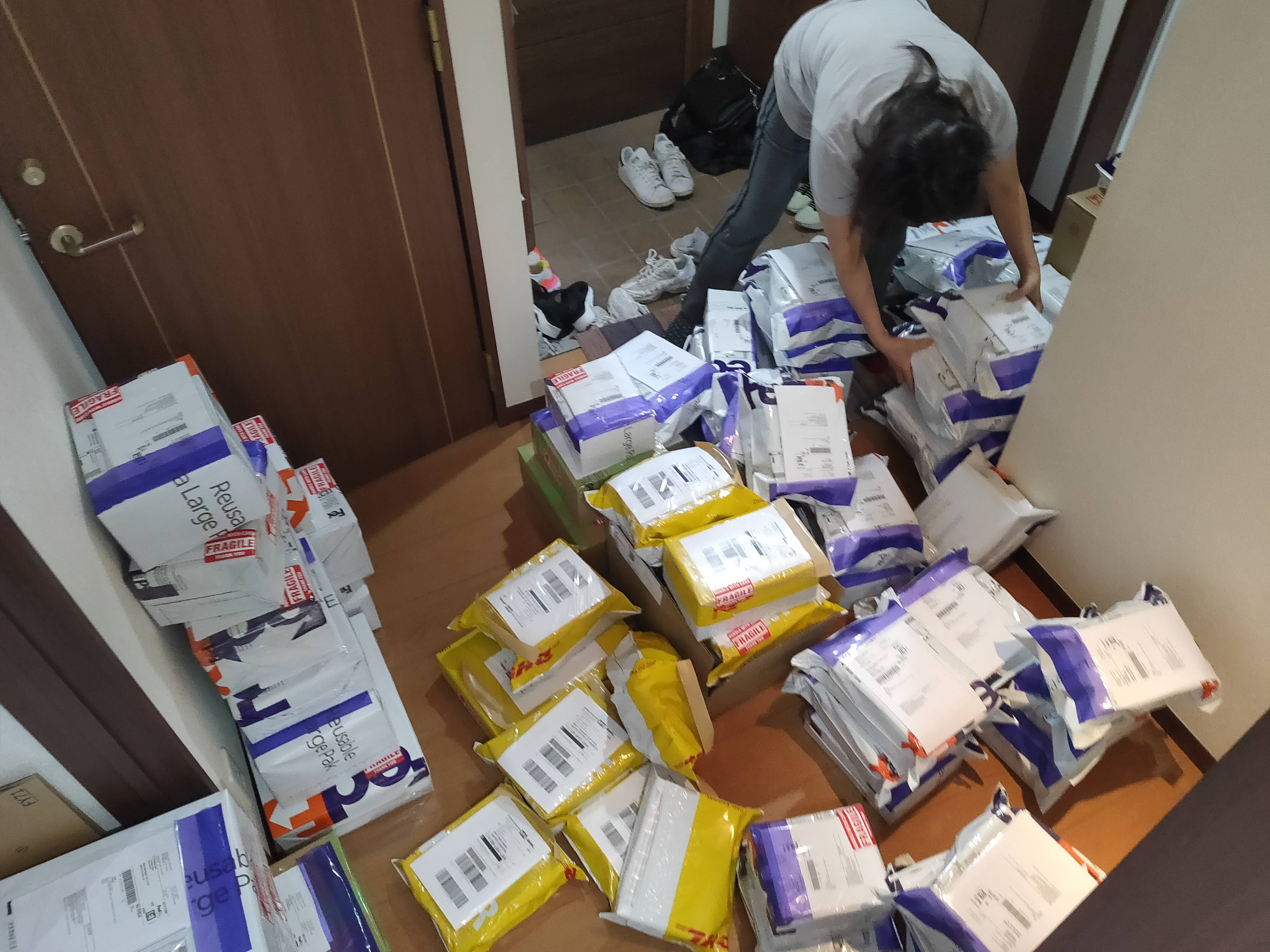
This photo was taken when my wife and I were handling international shipping from our home. We were preparing the packages at the front door before FedEx and DHL arrived to pick them up. (We now do this at a logistics warehouse.)
I was packing 50 to 100 items per day.
My wife was in charge of packing, and I was in charge of preparing the paperwork for FedEx and DHL.
My wife and I spent our days, from the moment we woke up until we went to bed, packing and shipping, with the only time we took a break to eat.
At first, we were both happy about the increase in orders. However, that only lasted a few days, and when it continued for nearly a week, all we did besides basic necessities was packing and paperwork.
My mental health is gradually deteriorating.
The conversation naturally died down. The only sounds between the two of us were the printer creating the FedEx invoice and the tape rustling as we packed the items; otherwise, we were both working silently.
At the time, it was the middle of Golden Week and I was working non-stop. I just wanted to be relieved as soon as possible.
Although we were both physically and mentally exhausted, I learned the necessary know-how for international shipping, such as how to write product names on invoices and how to assign HS codes. My wife also became able to pack items more efficiently while maintaining quality.
Naturally, we couldn't continue in this state forever, so we began to feel the need for a logistics warehouse.
At a certain point, we stopped handling logistics from our home, set up a logistics center near our office, hired staff, and prepared the necessary equipment.
The following are photos from when we first started.

We also created a break room.

The path to commercialization
Speaking of sending something overseas, there's a delivery service called EMS offered by the post office.
However, for those of us who ship large quantities of goods overseas, shipping costs become a significant factor. While it might not be a big deal for 10 items, when you have 1000 items, a difference of 100 yen in shipping costs can add up to a substantial expense over the course of a year.
Therefore, we considered options other than EMS and contracted with FedEx and DHL, which brings us to where we are today.
We developed software that automatically generates EMS, DHL, and FedEx invoices from our e-commerce order management screen. Now, operators can automate almost everything from overseas shipping and pickup to tracking number notification with simple steps. Using a thermal printer, we can now print invoices in bulk even for large-volume shipments.
Many young people start IT-related services, but I don't think many start logistics businesses. Looking back, our logistics business was an extension of our e-commerce business, and we started it because there wasn't a logistics service that suited our needs at the time.
日本語
English
简体中文
繁體中文